
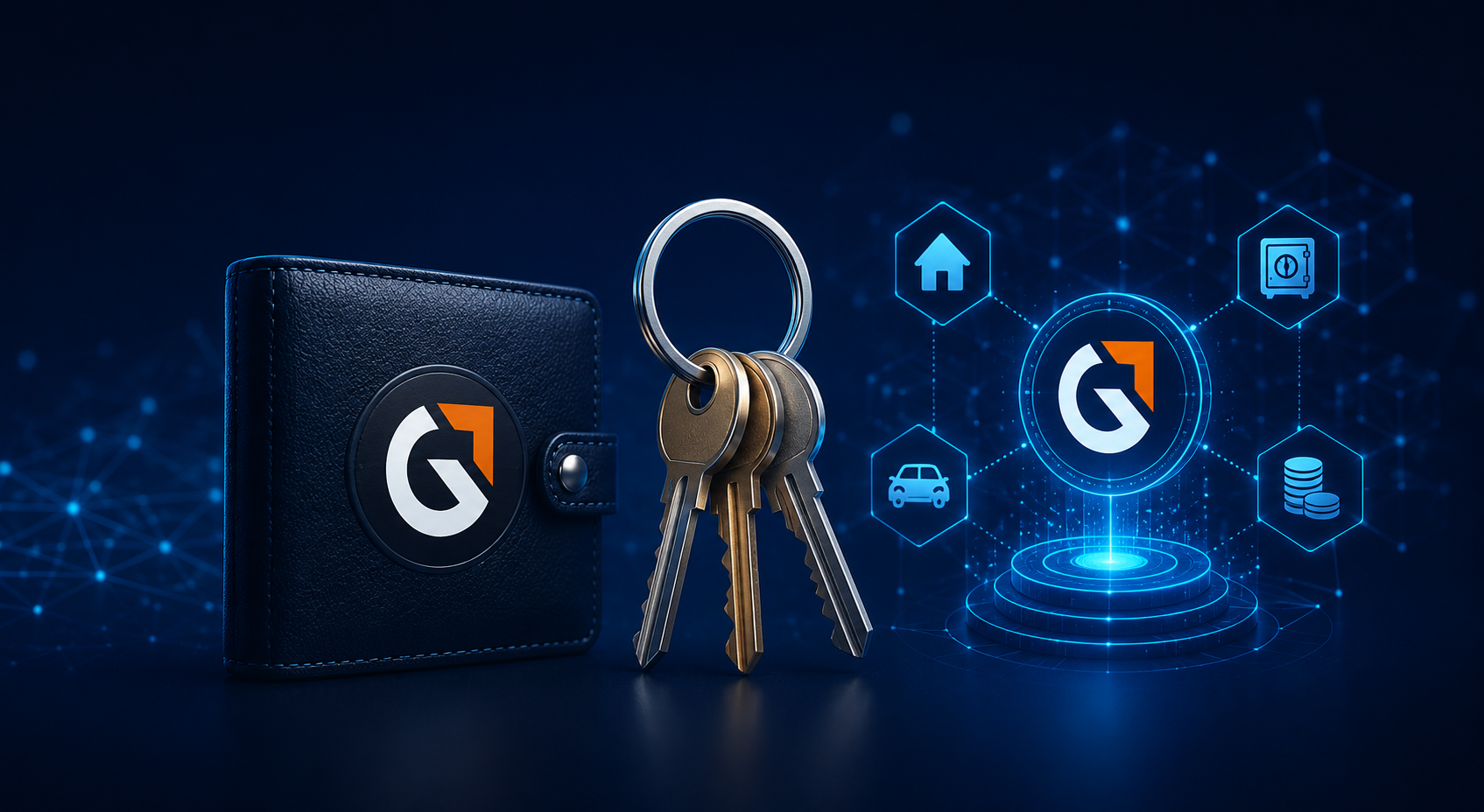
One of the biggest misconceptions about blockchain is the idea that a wallet actually stores cryptocurrency.
It sounds reasonable. After all, we carry physical wallets to hold cash, credit cards, and identification. So when someone hears the phrase “crypto wallet,” it’s natural to imagine that their digital coins are sitting inside an app or device somewhere.
In reality, that’s not how blockchain works.
THE KEY RING ANALOGY
A much better way to think about a blockchain wallet is as a digital key ring.
Imagine the keys you carry every day. Your house key doesn’t contain your home. Your car key doesn’t contain your vehicle. Your office key doesn’t store your workplace. Instead, each key proves that you have the authority to access something that exists somewhere else.
A blockchain wallet works in much the same way.
WHERE YOUR ASSETS ACTUALLY LIVE
Your digital assets aren’t stored inside the wallet itself. Instead, they exist as records on the blockchain—a shared, distributed ledger maintained by computers around the world. Your wallet securely stores the cryptographic keys that allow you to prove ownership and authorize transactions involving those assets.
When you want to send digital assets to someone else, your wallet doesn’t package up coins and move them across the internet. Instead, it uses your private cryptographic key to digitally sign a transaction. The blockchain network verifies that signature and updates its ledger to reflect the change in ownership.
The wallet is simply the tool that gives you access.
WHY PROTECTING YOUR WALLET MATTERS
That’s why protecting your wallet is so important.
If someone steals the keys to your house, they may be able to enter your home. Likewise, if someone gains access to your private keys, they may be able to authorize transactions involving your digital assets. The blockchain cannot distinguish between you and someone else holding your private key because possession of that key is what proves control.
The opposite is also true.
If you lose the keys to your home, getting back inside can be difficult. You may need a locksmith or even replace the locks. On a blockchain, there usually isn’t a locksmith. If you lose access to your private keys and have no recovery method, you may permanently lose the ability to control the assets associated with those keys.
SECURITY STARTS WITH YOUR KEYS
This is why blockchain places such a strong emphasis on security. Strong passwords, secure backups, recovery phrases, and hardware wallets all exist to help protect the digital keys that provide access to your blockchain accounts.
Once you understand this distinction, blockchain wallets become much less mysterious. They are not digital vaults filled with cryptocurrency. They are secure key management tools that allow you to interact with assets recorded on the blockchain.
REMEMBER THE KEY RING
The next time someone asks where cryptocurrency is stored, remember the key ring analogy.
Your keys don’t contain your house.
They simply give you access to it.
A blockchain wallet works exactly the same way.
DISCLAIMER
This article is provided for educational and informational purposes only and does not constitute financial, investment, legal, or tax advice. Nothing in this content should be interpreted as an offer, solicitation, or recommendation to purchase any security, digital asset, or investment product. Participation in blockchain networks does not guarantee financial returns or profits.