
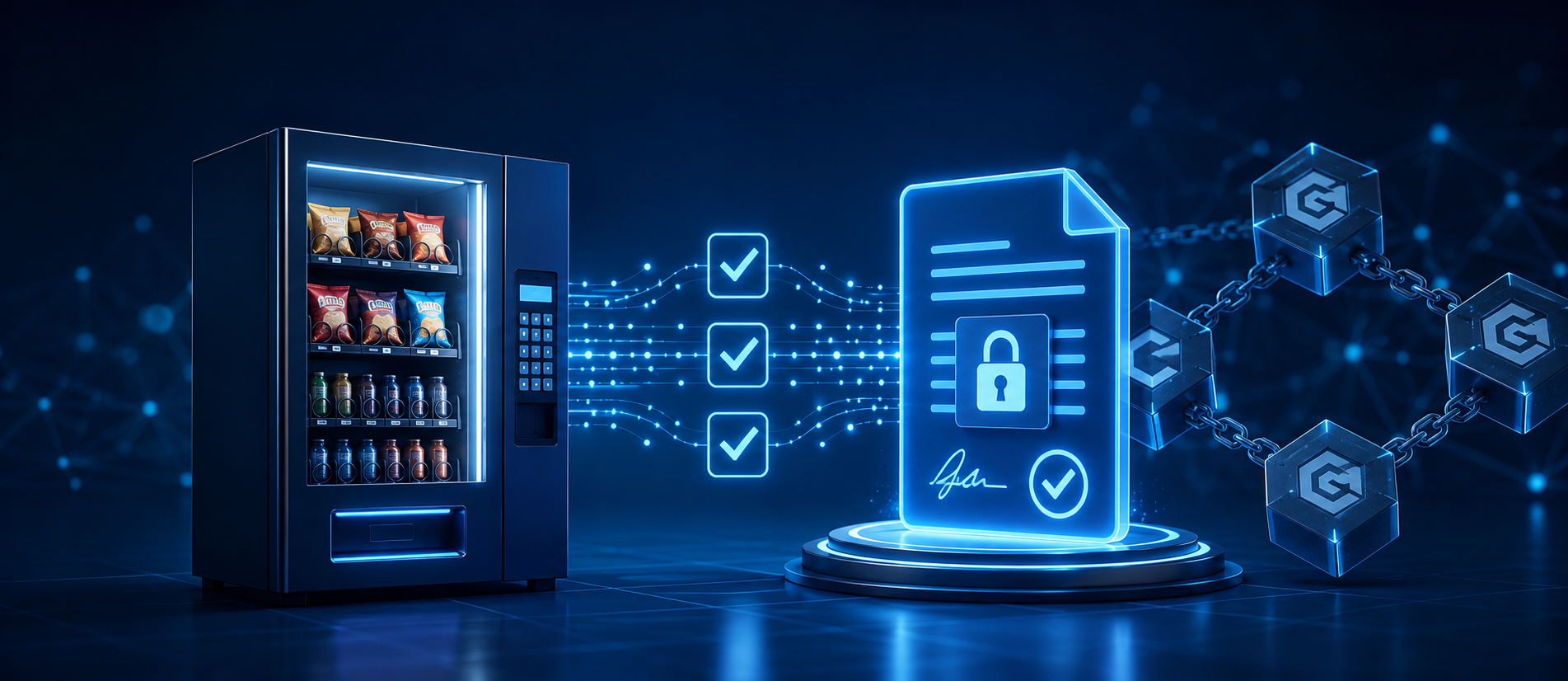
THE VENDING MACHINE ANALOGY
When people first hear the term smart contract, it often sounds like something complex or highly technical. The name can even be a little misleading because smart contracts are not contracts in the traditional legal sense. Instead, they are computer programs that automatically carry out instructions when specific conditions are met.
One of the easiest ways to understand a smart contract is to imagine a vending machine.
Most people have used one. You insert the correct amount of money, choose your item, and press the button. The machine checks that you’ve provided enough payment and, if everything matches the programmed rules, it immediately dispenses your snack.
There isn’t an employee inside the machine deciding whether you deserve the chips. There isn’t someone reviewing your purchase or approving the transaction. The vending machine simply follows the rules it was programmed to follow.
HOW SMART CONTRACTS WORK
Smart contracts work much the same way.
A smart contract is software that lives on a blockchain. It contains a set of predefined rules that automatically execute when the required conditions are satisfied. If those conditions are met, the programmed action occurs. If they are not, nothing happens.
For example, imagine a digital marketplace where someone wants to purchase a collectible stored on the Gnodi Blockchain. The smart contract can be programmed so that ownership transfers only after the agreed payment has been received. Once the payment is verified, the blockchain automatically completes the transfer. Neither party has to manually approve the transaction because the software follows the rules that were established ahead of time.
THE POWER OF AUTOMATION
This ability to automate processes is one of blockchain’s most powerful innovations.
Instead of relying on paperwork, emails, phone calls, or manual approvals, many routine processes can be executed automatically. The blockchain records the transaction, and the smart contract ensures that the agreed conditions are followed consistently every time.
CONSISTENCY AND PREDICTABILITY
Another important benefit is predictability.
A vending machine doesn’t decide to charge different prices depending on who walks up to it. It doesn’t randomly choose to dispense two snacks one day and none the next. As long as the machine is functioning correctly, it applies the same rules to everyone.
Smart contracts are designed with that same consistency in mind. Every participant interacting with the contract receives the same treatment because the software executes the same programmed logic each time it runs.
UNDERSTANDING THE LIMITS
Of course, just as a vending machine can only do what it was built to do, a smart contract can only perform the actions its developers programmed into it. It cannot make judgment calls or adapt its behavior on its own. If the rules need to change, a new version of the software may need to be deployed, depending on how the application was designed.
SMART CONTRACTS ON THE GNODI BLOCKCHAIN
On the Gnodi Blockchain, smart contracts give developers and organizations the tools to build decentralized applications that automate business processes, manage digital ownership, power governance systems, and support a wide range of other on-chain use cases. Rather than depending on a central authority to execute every action, the blockchain can verify conditions and perform those actions automatically according to transparent, predefined rules.
Like a vending machine, a smart contract isn’t making decisions—it is simply following instructions. When the right inputs are provided, the expected outcome happens automatically, consistently, and transparently. That simple concept is helping power a new generation of decentralized applications across blockchain networks like Gnodi.
DISCLAIMER
This article is provided for educational and informational purposes only and does not constitute financial, investment, legal, or tax advice. Nothing in this content should be interpreted as an offer, solicitation, or recommendation to purchase any security, digital asset, or investment product. Participation in blockchain networks does not guarantee financial returns or profits.