
THE RUSH HOUR PROBLEM
Anyone who has driven during rush hour knows how quickly traffic can come to a standstill.
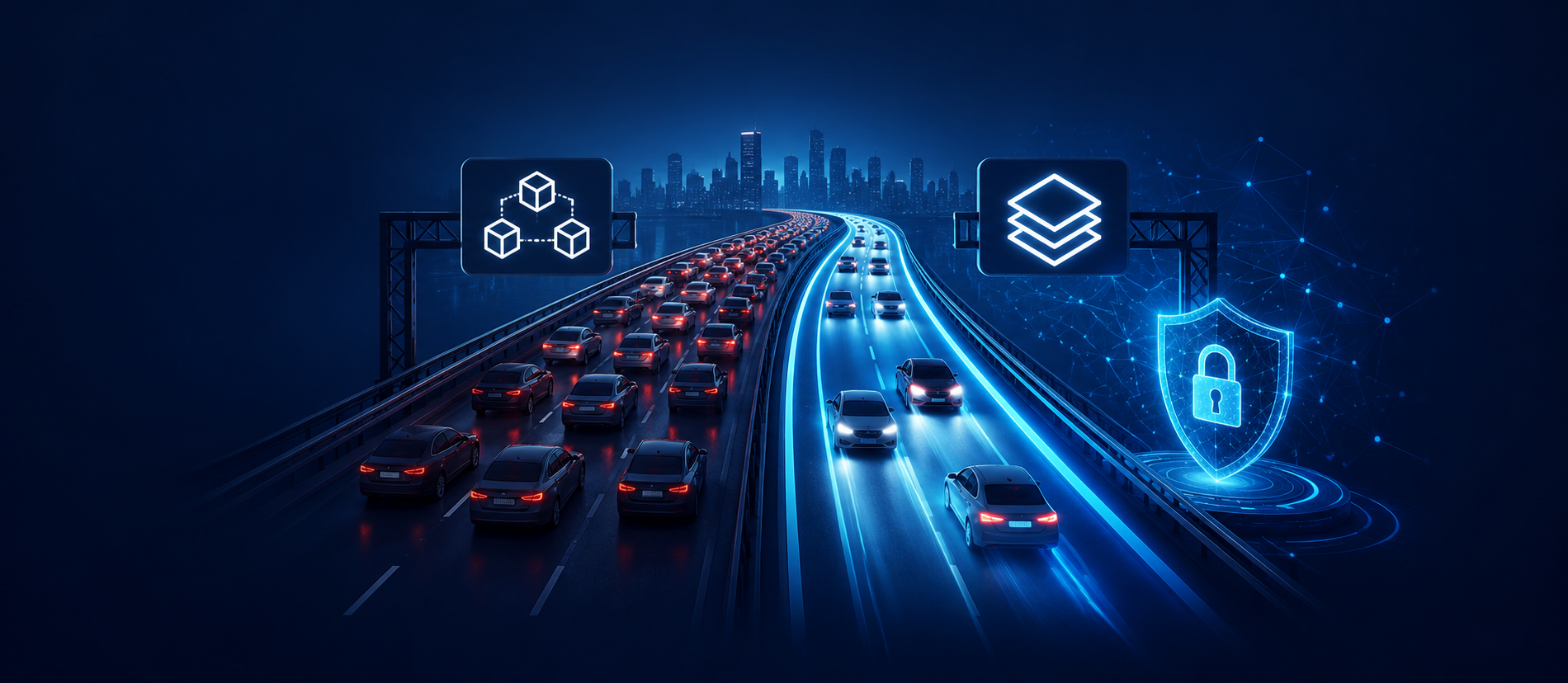
Thousands of vehicles are trying to use the same lanes at the same time. The highway itself isn’t broken. There are simply more cars than the road was originally designed to handle all at once.
Transportation engineers often solve this problem by adding express lanes alongside the main freeway.
Drivers who qualify for the express lane can move through traffic much more efficiently while still traveling toward the exact same destination. The original freeway remains the foundation of the transportation system, but the additional lanes help reduce congestion and improve the overall flow for everyone.
BLOCKCHAIN HAS THE SAME CHALLENGE
Layer 2 blockchain networks work in much the same way.
Every blockchain has a limit to how many transactions it can process in a given period of time. As more people use the network, transactions begin to compete for available space. This can lead to slower confirmation times and, on some networks, higher transaction fees.
Rather than rebuilding the entire blockchain from scratch, developers created Layer 2 networks.
HOW LAYER 2 WORKS
A Layer 2 network operates alongside the primary blockchain instead of replacing it. It processes large numbers of transactions independently before bundling the results together and submitting a final record back to the main blockchain.
Think of it as thousands of cars moving efficiently through an express lane before merging back onto the main highway near their destination.
THE DESTINATION NEVER CHANGES
The important point is that the destination never changes.
The primary blockchain remains the source of truth.
Layer 2 simply provides a faster and more efficient route for getting there.
This approach allows blockchain ecosystems to handle significantly more activity without requiring every individual transaction to compete for limited space on the main network. Users may experience quicker confirmations and reduced transaction costs, depending on the specific Layer 2 solution and network conditions at the time, while still benefiting from the security and integrity provided by the underlying blockchain.
WHY SCALABILITY MATTERS
As blockchain adoption continues to grow around the world, scalability becomes increasingly important. Financial applications, gaming platforms, supply chain systems, digital identity solutions, and tokenized real-world assets all generate enormous numbers of transactions. Without technologies like Layer 2, many blockchains would eventually become congested during periods of heavy demand.
Layer 2 solutions help ensure that blockchain networks can continue growing without sacrificing the qualities that made them valuable in the first place.
AN IMPORTANT MISCONCEPTION
The express lane analogy also highlights an important misconception.
The express lane is not a separate destination.
It is not a different transportation system.
It is simply a more efficient way to travel while remaining connected to the same highway.
Likewise, Layer 2 networks are not intended to replace Layer 1 blockchains. They extend their capabilities by handling activity more efficiently while ultimately relying on the main blockchain for final settlement and security.
THE FUTURE OF LAYER 2
As blockchain technology evolves, Layer 2 solutions are expected to play an increasingly important role in making decentralized applications faster, more affordable, and capable of supporting millions of users around the world.
Just as adding express lanes helped highways accommodate growing populations, Layer 2 networks are helping blockchain prepare for a future where digital assets, decentralized applications, and tokenized real-world assets (which may be subject to separate legal and regulatory considerations) become part of everyday life.
Educational Note: This article is intended for educational purposes to explain blockchain architecture using a real-world analogy. Different Layer 2 technologies use different methods for processing and settling transactions, but they all share the common goal of improving scalability while leveraging the security of an underlying blockchain.
DISCLAIMER
This article is provided for educational and informational purposes only and does not constitute financial, investment, legal, or tax advice. Nothing in this content should be interpreted as an offer, solicitation, or recommendation to purchase any security, digital asset, or investment product. Participation in blockchain networks does not guarantee financial returns or profits.