
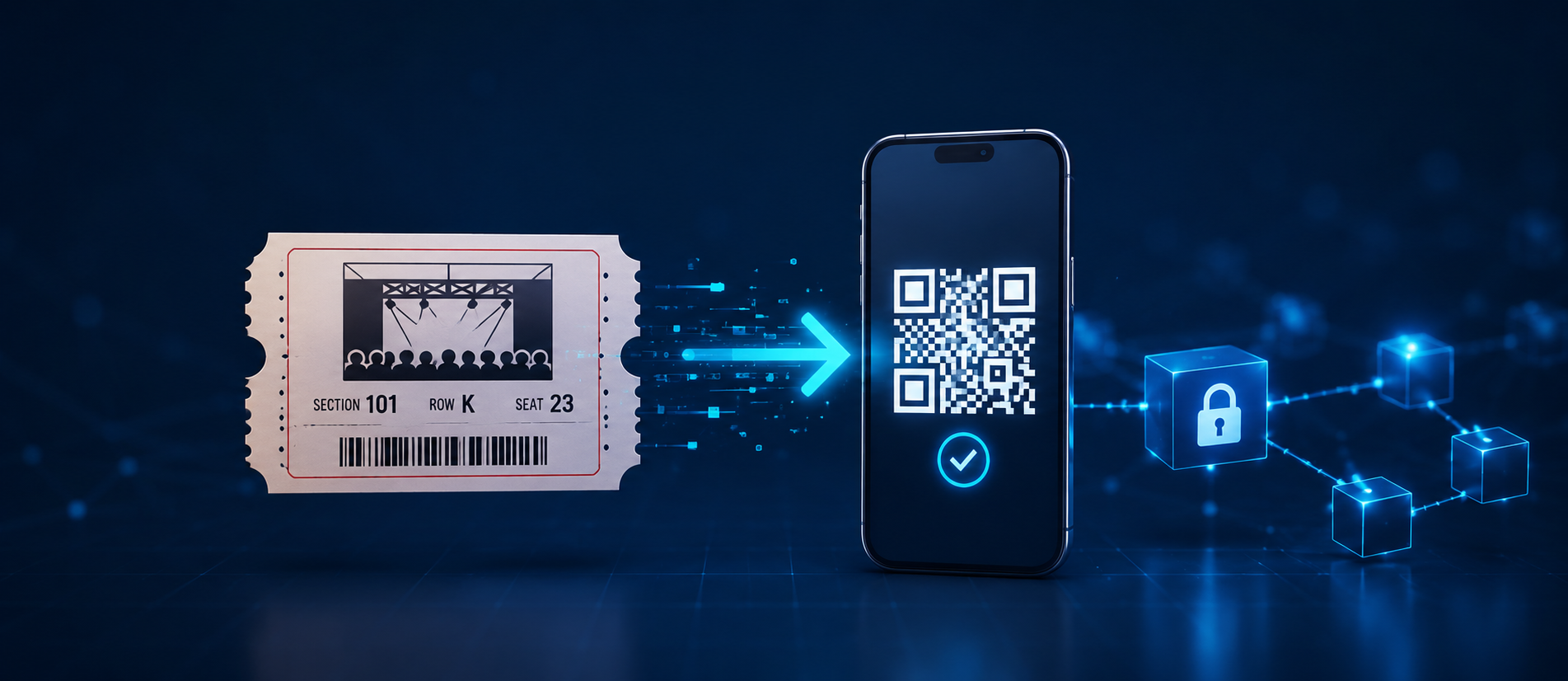
There was a time when going to a concert meant standing in line at a ticket office, carefully protecting a small piece of printed paper, and hoping it didn’t get lost, damaged, or copied.
That little paper ticket represented something valuable. It wasn’t the concert itself. It wasn’t the seat. It was simply proof that you had the right to be there.
Today, that same concert experience looks very different.
Instead of folded paper tucked into a wallet, most people arrive with nothing more than a QR code displayed on their phone. The venue scans it in seconds, verifies it instantly, and you’re on your way.
The concert didn’t change. The seat didn’t change. Your ownership of that seat didn’t change. Only the way your ownership was recorded changed.
That simple evolution provides one of the easiest ways to understand Real World Asset (RWA) tokenization.
THE ASSET DOESN’T BECOME DIGITAL
One of the biggest misconceptions surrounding tokenization is that people think blockchain somehow turns physical assets into digital ones.
It doesn’t.
A house is still a house. A vehicle is still a vehicle. A piece of farmland is still farmland. A gold bar still weighs exactly the same.
What changes is how ownership or certain rights associated with that asset are represented.
Instead of relying solely on paper documents, filing cabinets, spreadsheets, or disconnected databases, ownership information can also be represented securely on a blockchain.
Much like replacing a paper concert ticket with a QR code, the underlying asset never changes. The record does.
WHY PAPER ISN’T ALWAYS ENOUGH
Paper has served humanity remarkably well.
For centuries we’ve documented ownership through deeds, certificates, titles, contracts, receipts, and licenses.
But paper has weaknesses.
It can be lost. It can be forged. It can be altered. It can be destroyed by floods, fires, wars, or simple human error.
Entire legal systems have been built around trying to determine which pieces of paper are authentic and which are not.
Anyone who has ever lost an important document understands the anxiety that follows.
Now imagine that problem affecting your family’s home. Or your farm. Or an entire community’s land records.
A GLOBAL PROBLEM
This isn’t a theoretical issue.
Around the world, countries continue to struggle with incomplete, outdated, or paper-based ownership records.
As widely reported by international development organizations, maintaining accurate land registries remains one of the largest challenges facing many developing nations. In many regions, property records remain vulnerable to tampering, loss, inconsistent updates, and competing ownership claims.
In parts of Africa, land disputes have become so common that individuals have discovered multiple people claiming ownership of the very same property. Cases have been documented in Kenya where parallel paper titles created years of legal uncertainty and expensive court battles. These challenges have led several countries—including Georgia, Rwanda, and Honduras—to explore blockchain-based land registration systems.
These aren’t technology problems. They’re record-keeping problems.
THE PHILIPPINES FACES SIMILAR CHALLENGES
The Philippines provides another example of why modernizing ownership records matters.
Like many countries, the Philippines has spent years working to improve and digitize land administration. Historical paper records, fragmented registries, overlapping documentation, and lengthy verification processes have all contributed to delays and disputes involving property ownership. Improving land governance has become an important national objective because clear ownership records directly affect investment, lending, infrastructure development, and economic growth.
Imagine purchasing land, only to spend months—or even years—trying to verify every historical document connected to it.
Now imagine much of that verification existing on a secure, auditable digital ledger where every authorized update leaves a permanent history.
That doesn’t eliminate legal processes. It doesn’t remove governments. It doesn’t magically solve fraud. But it can make ownership records significantly more transparent and far easier to audit.
BLOCKCHAIN DOESN’T REPLACE REALITY
This distinction is incredibly important.
Blockchain cannot determine whether someone legally owns an asset. It cannot verify whether a survey was accurate. It cannot inspect a building. It cannot confirm whether a government made the correct decision.
Blockchain faithfully records the information that authorized parties place onto it.
That’s why blockchain professionals often say: “Garbage in, garbage forever.”
If incorrect information is entered, blockchain preserves that incorrect information exceptionally well.
For tokenization to work effectively, the legal documentation surrounding the asset must already be trustworthy.
Blockchain strengthens recordkeeping. It does not replace due diligence.
WHY TOKENIZATION MATTERS
Once ownership is represented digitally, entirely new possibilities begin to emerge.
Ownership transfers may become more efficient. Audits may be easier to conduct because every authorized change leaves an immutable history. Organizations may be able to reduce reconciliation between disconnected databases. Financial institutions may find record verification more straightforward. Governments can modernize public registries. Businesses can streamline operations. And individuals may gain greater confidence that ownership records have not been silently modified.
Again, notice what isn’t changing.
The house isn’t changing. The farmland isn’t changing. The artwork isn’t changing. Only the ledger changes.
FROM FILING CABINETS TO DIGITAL TRUST
Every generation upgrades the way it stores important information.
We replaced handwritten ledgers with spreadsheets. Paper maps became GPS. Printed boarding passes became mobile check-in. Paper concert tickets became QR codes.
Tokenization represents another step in that same progression.
It isn’t about making the physical world disappear. It’s about creating better systems for recording, verifying, and transferring ownership in an increasingly digital economy.
THE BIGGER PICTURE
When people hear terms like Real World Assets or RWA tokenization, they often imagine something complicated.
In reality, the core idea is surprisingly simple.
A blockchain token doesn’t replace the real-world asset. It represents rights associated with that asset in a secure digital format.
Just as your QR code isn’t the concert itself—but reliably proves your right to attend—tokenization creates a modern way to represent ownership while leaving the underlying asset exactly where it has always been.
The concert is still the concert. Your seat is still your seat. The difference is that proving you own it has entered the digital age.
DISCLAIMER
This article is provided for educational and informational purposes only and does not constitute financial, investment, legal, or tax advice. Nothing in this content should be interpreted as an offer, solicitation, or recommendation to purchase any security, digital asset, or investment product. Participation in blockchain networks does not guarantee financial returns or profits.