
One of the most common questions in cryptocurrency is also one of the simplest: where does the price come from? Many people assume there’s an official price set somewhere behind the scenes. There isn’t.
The price of a digital asset — including $GNOD — comes from one thing: people buying and selling it. When more people want to buy than to sell, the price moves up. When more want to sell than to buy, it moves down. That buying and selling is driven by sentiment — what participants believe, expect, and decide to do. Nothing more.
To understand how buyers and sellers actually find each other, it helps to look at something most people already know: real estate.
REAL ESTATE AND THE MLS
When you sell a house, you don’t shout into the void and hope someone walks by. You list it on the MLS — the Multiple Listing Service. The MLS is a shared database that brings buyers and sellers together in one place. Agents list properties, buyers browse them, and a deal happens when a buyer and a seller agree on a price.
The MLS solves the discovery problem. But it doesn’t solve the waiting problem.
Even with a great listing, you still have to wait for a buyer to show up, make an offer, negotiate, and close. And real estate has seasons. Spring is when buyers come out. List in the wrong month and your house can sit for a long time, even at a fair price.
THE ORDER BOOK: A DIGITAL MLS
A traditional exchange works a lot like the MLS. It runs an order book — a list of people who want to buy and a list of people who want to sell. The exchange matches them together.
It’s a solid system, but it carries the same limitation as selling a house. To sell, you need a buyer on the other side at that exact moment. If no one is buying the amount you want to sell, you wait — your “house” sits on the market.
THE LIQUIDITY POOL: A BUYER WHO IS ALWAYS HOME
This is the problem a liquidity pool solves.
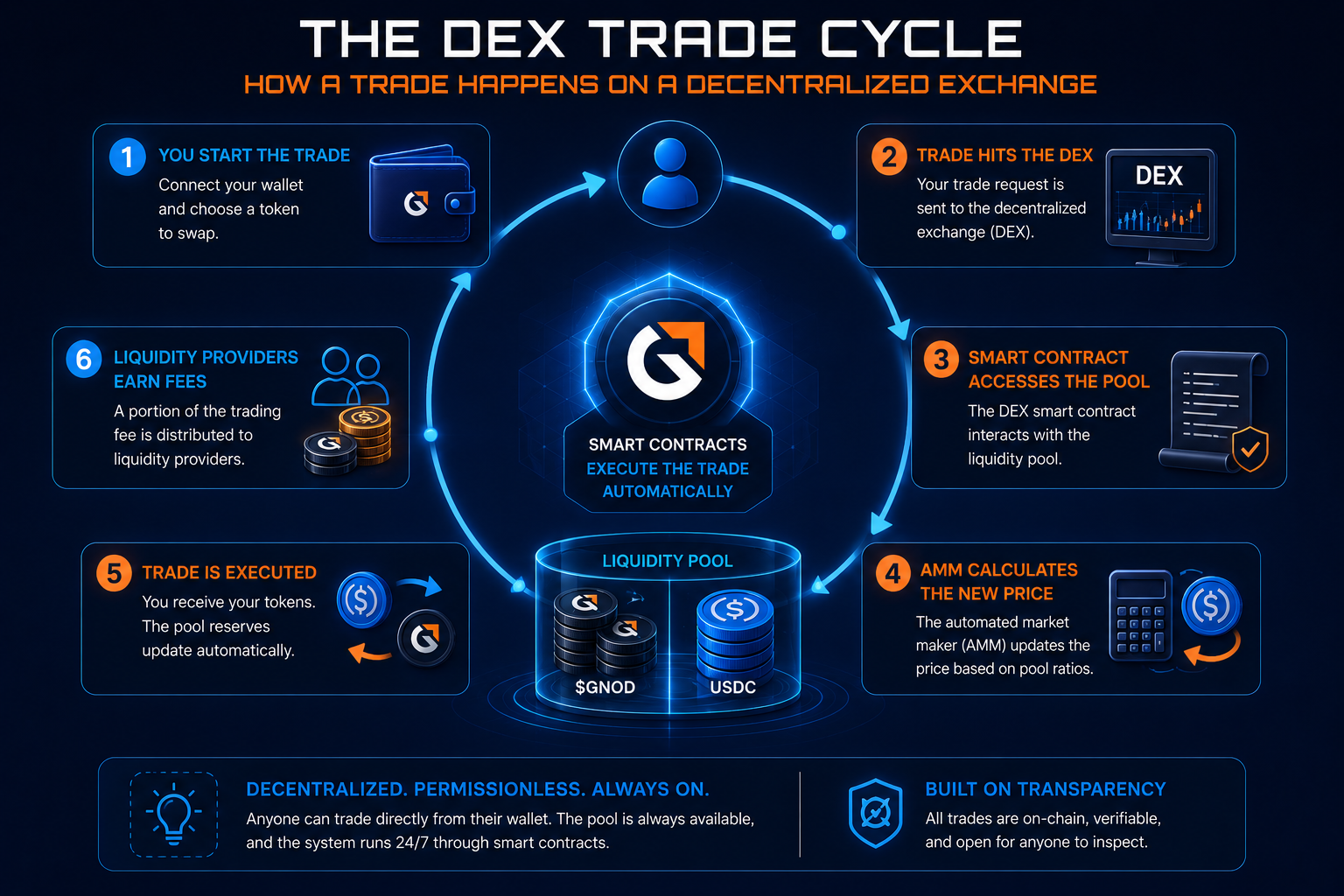
A liquidity pool is a reserve of tokens locked inside a smart contract, standing by and ready to trade at any time. Instead of waiting for a matching buyer or seller, you trade directly against the pool. The pool is always there. It never goes home for the night, and it never waits for spring.
Here’s how the pieces fit together:
- The liquidity pool is a smart contract holding a reserve of two paired assets — for example, $GNOD and a base asset.
- Liquidity providers are the people who deposit those tokens into the pool so it always has something to trade with.
- A decentralized exchange (DEX) is the platform where you swap one token for the other.
- An automated market maker (AMM) is the formula that sets the price automatically based on what’s in the pool.
In real estate terms: a liquidity pool is like having a buyer permanently parked at your address, ready to purchase the moment you decide to sell — and a seller ready the moment you decide to buy. The tokens are already standing by in the smart contract and your wallet, so you no longer wait until spring to sell your $GNOD.
HOW THE POOL SETS THE PRICE
The pool doesn’t guess at a price. It calculates one.
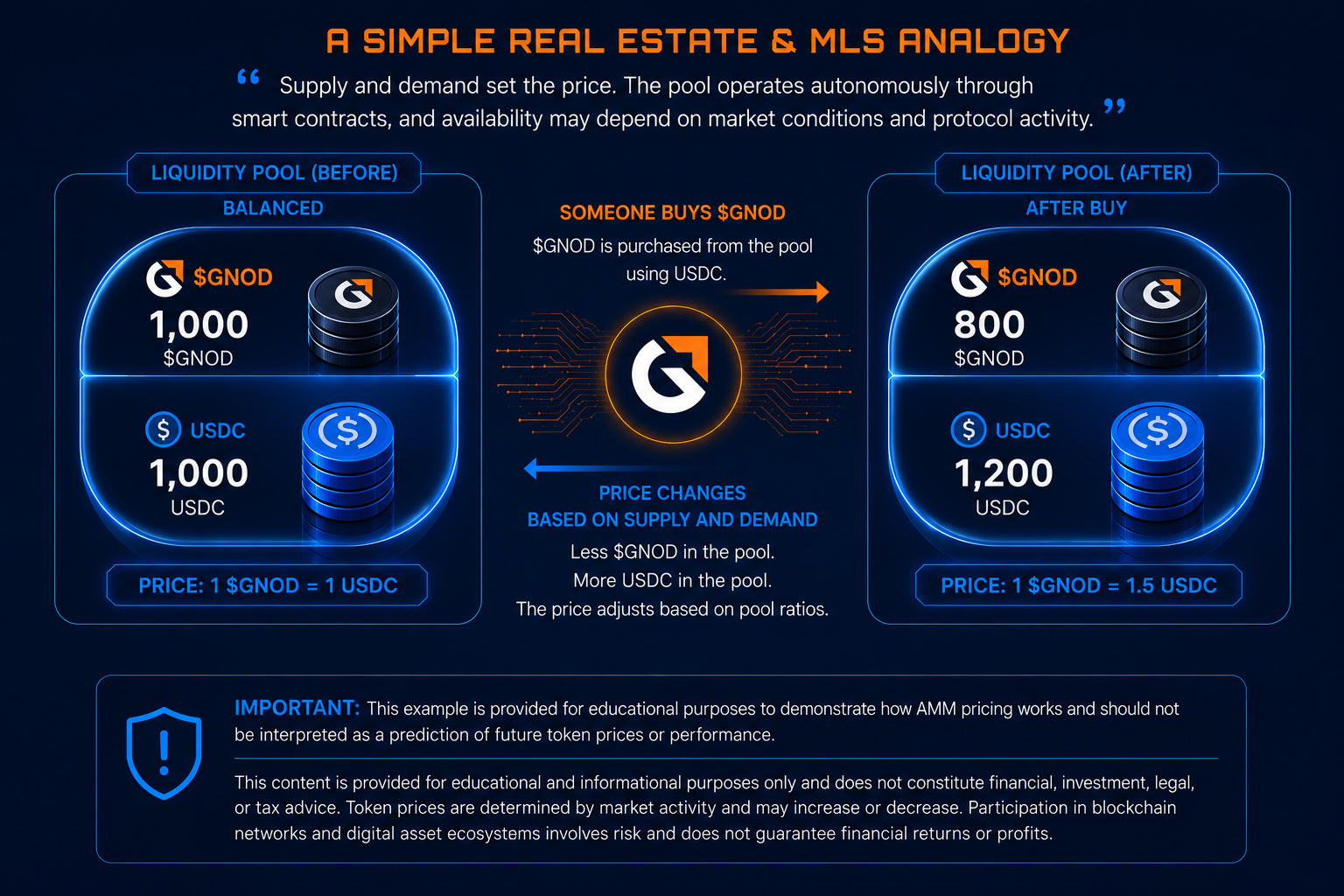
Most pools follow a simple rule: the two assets are kept in balance, and the price is the ratio between them. When someone buys $GNOD from the pool, the amount of $GNOD in the pool goes down and the paired asset goes up — so the price of $GNOD rises. When someone sells $GNOD into the pool, the opposite happens and the price falls.
That’s the whole engine. Buying pushes the price up, selling pushes it down, and the smart contract does the math instantly and automatically. Sentiment is what makes people decide to buy or sell; the pool simply turns those decisions into a price.
THE SIMPLE TAKEAWAY
A liquidity pool is like a buyer and a seller who are always home.
The MLS brings buyers and sellers together, but you still wait for a counterparty — and sometimes for spring. A liquidity pool keeps tokens standing by inside a smart contract, so a trade can happen the moment you want it to. The price isn’t set by anyone in charge. It’s set by buying and selling, driven by sentiment. Nothing more.
In simple terms: “The MLS introduces buyers and sellers. A liquidity pool makes sure one is always standing by.”
DISCLAIMER
This article is provided for educational and informational purposes only and does not constitute financial, investment, legal, or tax advice. Nothing in this content should be interpreted as an offer, solicitation, or recommendation to purchase any security, digital asset, or investment product. Participation in blockchain networks does not guarantee financial returns or profits.