
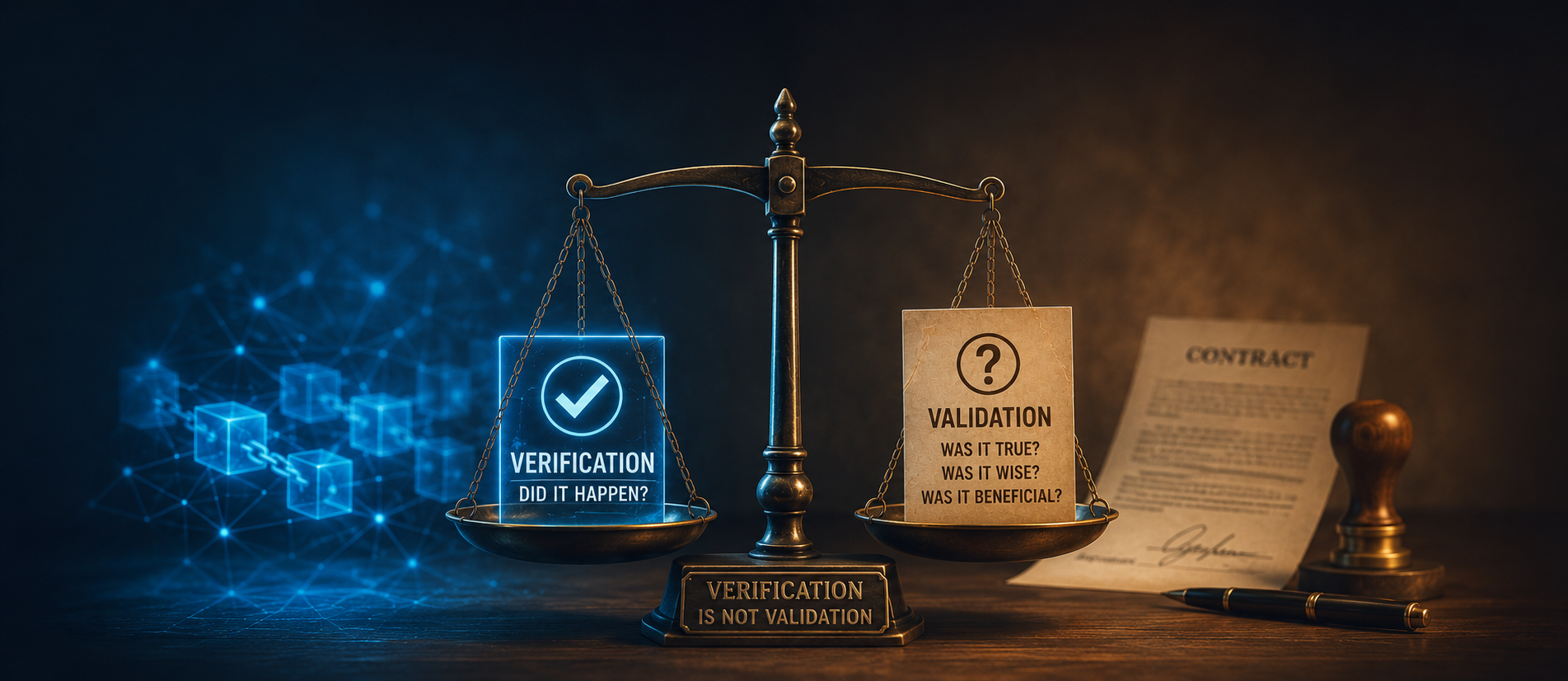
Blockchain technology has introduced one of the most important innovations in modern computing: the ability to create a shared record of events that cannot easily be altered or manipulated. For many people entering the world of digital assets, this capability creates a sense of confidence that is both understandable and, at times, dangerous.
Because blockchain records are transparent and immutable, many newcomers assume that anything recorded on a blockchain must therefore be legitimate. If a transaction occurred, if a token exists, or if funds were transferred, the thinking often follows that the activity itself has somehow been validated by the technology.
In reality, blockchain makes no such promise.
Understanding this distinction may be one of the most valuable lessons a person can learn if they choose to explore cryptocurrency, decentralized finance, or blockchain governance.
A simple real-world analogy helps explain why.
THE NOTARY PUBLIC ANALOGY
Most people are familiar with the role of a notary public. When an important document is signed, a notary verifies the identity of the signer, witnesses the signing process, and applies an official seal. That seal carries significance because it creates confidence that the signature is authentic and that the signing event actually occurred.
What the notary does not do is equally important.
The notary does not determine whether the contract is fair. The notary does not evaluate whether the promises made within the document are truthful. The notary does not investigate whether signing the agreement is financially wise or personally beneficial. The notary’s responsibility is limited to verifying that the signing event took place and that the individuals involved were properly identified.
Blockchain technology performs a remarkably similar function.
A blockchain verifies that a transaction occurred. It records when it happened, which wallet addresses participated, and what assets changed hands. Once validated by the network, that information becomes part of a permanent ledger that can be independently reviewed by anyone.
However, just as a notary does not guarantee the quality of a contract, a blockchain does not guarantee the quality of a transaction.
THE DIFFERENCE BETWEEN VERIFICATION AND VALIDATION
One of the most common mistakes in the digital asset industry is confusing verification with validation.
Verification answers the question, “Did this happen?” Validation answers the question, “Was this a good idea?”
Blockchain is exceptionally good at answering the first question. In fact, that is precisely what it was designed to do. Through cryptography, consensus mechanisms, and distributed recordkeeping, blockchain networks create confidence that recorded events occurred as described.
What blockchain cannot do is determine whether those events were wise, ethical, profitable, or honest.
A blockchain can verify that someone transferred funds into a project. It cannot determine whether the project will succeed.
A blockchain can verify that a token was created. It cannot determine whether the token has meaningful utility.
A blockchain can verify that a governance vote occurred. It cannot determine whether the community made the best decision.
These judgments remain the responsibility of people, not technology.
WHY FRAUD STILL EXISTS ON BLOCKCHAIN NETWORKS
Critics of cryptocurrency often point to fraud as evidence that blockchain technology has failed. In reality, fraud on a blockchain does not demonstrate a failure of the technology. More often, it demonstrates a misunderstanding of what the technology was designed to accomplish.
Consider a hypothetical project that launches a new token and promises extraordinary returns. Thousands of individuals purchase the asset. Funds flow into the project’s wallets, and every transaction is accurately recorded on the blockchain. Months later, the founders abandon the project, development stops, and participants suffer losses.
From a technical perspective, the blockchain worked perfectly.
Every transaction was recorded. Every transfer was preserved. Every movement of funds remained visible for anyone willing to inspect the ledger.
The problem was never that the blockchain failed to document events. The problem was that many participants mistakenly assumed the existence of a transparent record somehow validated the claims being made by the people behind the project.
The ledger was accurate. The promises were not.
TRANSPARENCY IS A TOOL, NOT A GUARANTEE
One of blockchain’s greatest contributions to society is transparency. Unlike many traditional systems where information is fragmented across institutions and databases, blockchain networks allow participants to inspect activity directly. This level of visibility can increase accountability and reduce certain forms of corruption or manipulation.
Transparency, however, should never be confused with truth.
A security camera provides an accurate record of what occurred in a parking lot. It does not tell investigators why something happened or whether the individuals involved were acting honestly. The footage becomes evidence, but human judgment is still required to interpret what is being observed.
Blockchain functions in much the same way. It provides evidence of activity, but it does not eliminate the need for critical thinking, due diligence, or personal responsibility.
Technology can provide information. Wisdom is still required to interpret it.
WHY THIS MATTERS FOR NODE OPERATORS AND COMMUNITY MEMBERS
For node operators and active participants in blockchain ecosystems, this lesson is particularly important. Much of the conversation within our industry focuses on infrastructure, staking, governance, rewards, tokenomics, and technical innovation. While these topics deserve attention, they should never replace thoughtful evaluation of the projects and communities we choose to support.
Every participant should develop the habit of asking difficult questions.
- Who is building the project?
- What problem is being solved?
- How does the business model work?
- What incentives exist for founders, developers, and community members?
- Are the claims being made supported by evidence?
- Is the governance structure designed to create accountability?
These questions cannot be answered by a blockchain explorer, a wallet address, or a transaction hash. They require analysis, judgment, and sometimes healthy skepticism.
The blockchain can show you what happened. It cannot tell you what to believe.
THE REAL PROMISE OF BLOCKCHAIN
The true value of blockchain technology is not that it eliminates the need for trust. Rather, it reduces uncertainty about recorded events. By creating transparent and immutable ledgers, blockchain gives individuals access to information that was previously controlled by centralized institutions.
That achievement is significant.
Yet it remains important to understand the boundaries of what the technology can and cannot do.
Blockchain can verify activity. Blockchain can preserve history. Blockchain can create transparency.
What blockchain cannot do is replace human judgment.
As the digital asset industry continues to mature, those who understand this distinction will be better equipped to recognize opportunity, avoid unnecessary risk, and contribute meaningfully to the communities they support.
CONCLUSION
Perhaps the most important takeaway is this:
Verification is not validation.
A notary public verifies that a signature was made. The notary does not guarantee that signing the document was a wise decision.
Likewise, a blockchain verifies that a transaction occurred. It does not guarantee that the transaction was honest, beneficial, or financially sound.
The technology is powerful, but it was never intended to replace wisdom. Its purpose is to create confidence in the accuracy of the record, not confidence in the quality of the decisions recorded within it.
Understanding that distinction may be one of the most effective defenses against fraud in the entire blockchain industry.
DISCLAIMER
This article is provided for educational and informational purposes only and does not constitute financial, investment, legal, or tax advice. Nothing in this content should be interpreted as an offer, solicitation, or recommendation to purchase any security, digital asset, or investment product. Participation in blockchain networks does not guarantee financial returns or profits.