
THE CONCERT TICKET ANALOGY
Have you ever tried to buy concert tickets for a popular event?
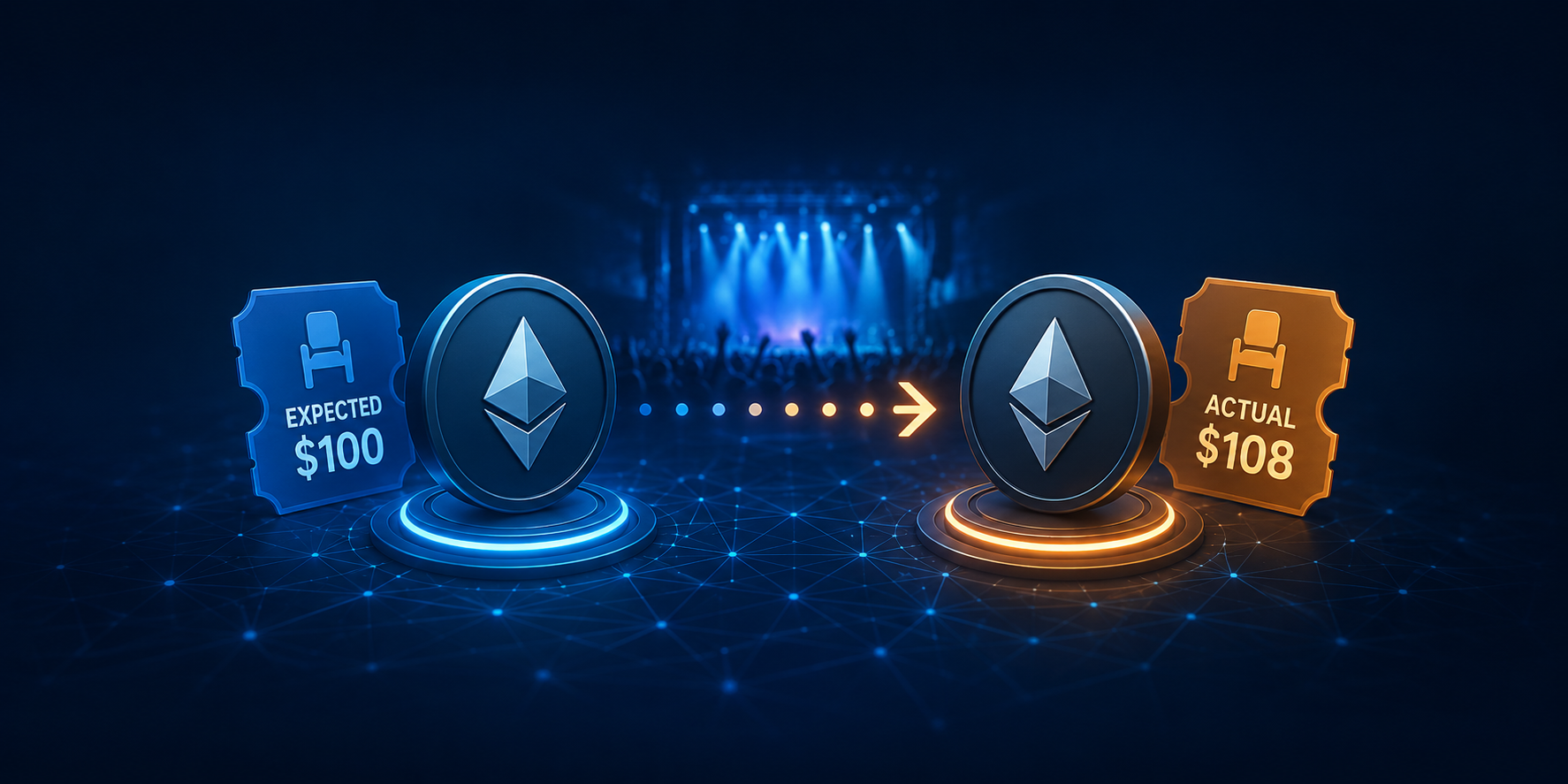
You log in the moment tickets become available. The website shows seats for $100, and you quickly click the purchase button. Everything appears straightforward until the final confirmation screen appears and informs you that the tickets now cost $108.
Most people have experienced some version of this situation. The website did not malfunction, and nobody necessarily made a mistake. Instead, thousands of buyers were attempting to purchase tickets at the same time. Between the moment you saw the price and the moment your order was processed, market demand changed.
This everyday experience provides one of the simplest ways to understand a blockchain concept known as slippage.
WHAT IS SLIPPAGE?
Slippage occurs when the price you expect to receive for a trade differs slightly from the price you actually receive when the transaction is completed.
When someone initiates a transaction on a blockchain, the trade is not executed instantaneously. The transaction must first be submitted to the network, processed, and confirmed. During that brief period, market activity may continue to change the price of the asset being traded.
As a result, the final execution price may be slightly higher or lower than the quoted price that was displayed when the trade was initiated. The difference between those two prices is known as slippage.
WHY SLIPPAGE HAPPENS
To understand why slippage occurs, it helps to return to our concert ticket example.
Imagine there are thousands of fans attempting to buy tickets simultaneously. As tickets are purchased, fewer remain available. The remaining inventory becomes more valuable, causing prices to adjust. By the time your purchase request reaches the system, the original ticket price may no longer be available.
Blockchain markets operate in much the same way. Buyers and sellers are constantly interacting, and prices continuously adjust based on supply and demand. Even a short delay between placing and executing a transaction can result in a different price than the one originally displayed.
In highly active markets, those changes may be very small. In less active markets, they can be more noticeable.
THE ROLE OF LIQUIDITY
Liquidity plays a significant role in determining how much slippage a trader may experience.
Imagine a concert venue with only a handful of seats remaining. A few buyers entering the market can dramatically affect pricing because inventory is limited. Now imagine a stadium with tens of thousands of available seats. A single purchase would have very little impact on the overall market.
The same principle applies to digital asset markets. Markets with deeper liquidity generally experience less slippage because there are more assets available to support trading activity. Markets with lower liquidity often experience greater price movement when larger trades are placed.
This is one reason why traders often pay attention to liquidity in addition to price.
SLIPPAGE IS NOT A FEE
A common misunderstanding is that slippage represents a hidden fee charged by the blockchain or trading platform.
In reality, slippage is not a fee at all.
A transaction fee is a known cost charged for processing a transaction. Slippage is simply the result of market prices changing while a transaction is being executed.
Using our concert analogy, the service charge added by the ticket provider would be a fee. The ticket price increasing because other people purchased tickets before your order was completed would be slippage.
Although both may affect the final amount paid, they are fundamentally different concepts.
WHY TRADING PLATFORMS USE SLIPPAGE TOLERANCE
Many decentralized exchanges allow users to set a slippage tolerance before submitting a trade. This setting establishes the maximum amount of price movement a user is willing to accept.
Think of it as telling the ticket website:
“I am willing to pay up to $105 for this ticket, but if the price rises beyond that amount, cancel the purchase.”
Blockchain trading platforms use the same idea. If the market moves beyond the user’s specified tolerance before the transaction is executed, the trade may be rejected rather than completed at an unexpected price.
This feature helps users maintain greater control over their transactions in rapidly changing markets.
THE BIGGER LESSON
Slippage is not unique to blockchain technology. It is simply a reflection of how markets function whenever prices are changing in real time.
It happens when purchasing concert tickets, booking airline seats, buying stocks, exchanging currencies, and trading digital assets. Anytime supply, demand, and timing interact, there is the possibility that the price visible at one moment may differ from the price available a few seconds later.
Blockchain did not invent this behavior. It merely makes it more visible.
Understanding slippage helps participants better understand how markets operate and why transaction prices may occasionally differ from expectations. Like many blockchain concepts, it sounds technical at first, but once viewed through a familiar real-world example, it becomes much easier to understand.
DISCLAIMER
This article is provided for educational purposes only and should not be considered financial, investment, legal, or tax advice. Digital asset markets involve risk, and market conditions can change rapidly. Always conduct your own research and consult qualified professionals regarding your specific circumstances.