
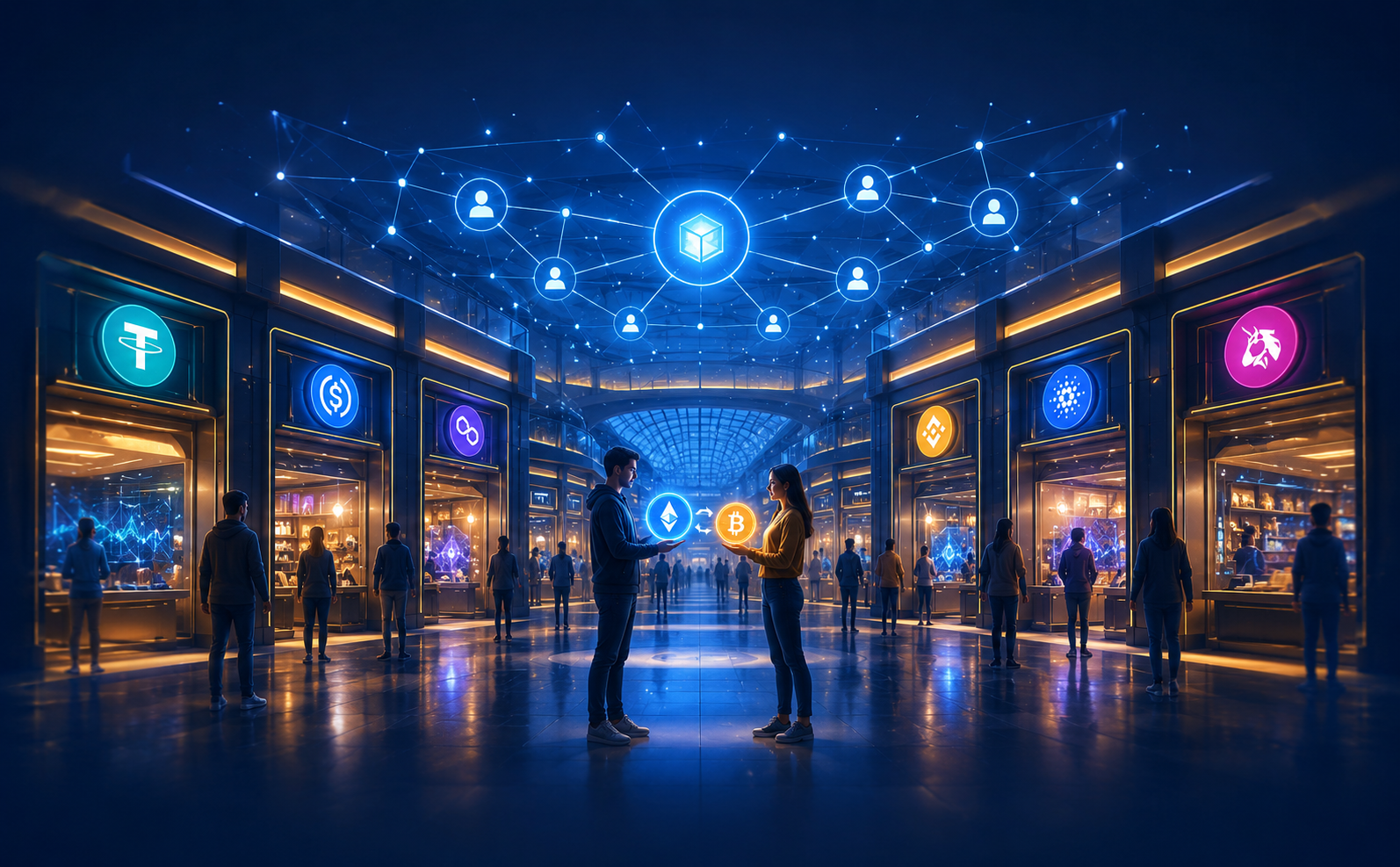
One of the most important innovations in blockchain technology is the Decentralized Exchange, commonly known as a DEX. While the term may sound technical, the concept itself is surprisingly familiar. In fact, most people have visited a real-world version of a DEX many times without realizing it. A useful way to understand how a decentralized exchange works is to think about a shopping mall.
When people visit a shopping mall, they are entering a place designed to bring buyers and sellers together. The mall itself does not manufacture shoes, jewelry, clothing, or electronics. It simply provides the infrastructure that allows many different businesses to operate under one roof. Customers can move freely from store to store, comparing products, prices, and offerings before deciding where to spend their money.
A decentralized exchange functions in much the same way. Instead of bringing together physical stores and shoppers, a DEX creates a digital marketplace where people can exchange one cryptocurrency or digital asset for another. The exchange itself does not own the assets being traded. Rather, it provides the infrastructure that allows participants to interact directly with one another.
LIQUIDITY POOLS: THE STORES INSIDE THE MALL
The shopping mall analogy becomes even more useful when we look at liquidity pools. In a mall, each store serves a specific purpose. One store may specialize in shoes while another focuses on sporting goods or electronics. Every retailer maintains its own inventory and serves a unique customer need. On a decentralized exchange, liquidity pools serve a similar function. Each pool contains a specific combination of digital assets and allows users to trade between those assets. One pool may facilitate exchanges between GNOD and USDC, while another may support trades involving completely different tokens.
When a user wants to make a trade, they are essentially choosing which store to visit inside the digital mall. The liquidity pool provides the assets needed to complete the transaction, while the DEX provides the marketplace where those pools can be discovered and accessed.
HOW A DEX DIFFERS FROM A CENTRALIZED EXCHANGE
This structure differs significantly from a traditional centralized exchange. A centralized exchange operates more like a large department store. The company controls the environment, manages custody of assets, and oversees much of the transaction process. A decentralized exchange, by contrast, allows users to maintain greater control of their assets by interacting directly with the underlying smart contracts and liquidity pools. Rather than handing assets to a central intermediary, participants typically connect their own wallets and authorize transactions themselves.
WHY VARIETY AND LIQUIDITY MATTER
Another interesting similarity between shopping malls and decentralized exchanges is the importance of variety. Imagine comparing a mall with only three stores to a mall with three hundred stores. Most shoppers would naturally gravitate toward the larger mall because it offers more choices and creates a more useful destination. The same principle often applies to decentralized exchanges. As more liquidity pools are added and more participants contribute assets, the exchange becomes more valuable to users. Greater liquidity can improve trading efficiency and provide access to a wider range of digital assets.
WHAT THE MARKETPLACE REALLY DOES
Perhaps the most important lesson from the shopping mall analogy is understanding what the mall actually does. A shopping mall does not exist to sell products directly. Its purpose is to create an environment where commerce can take place. A decentralized exchange serves a similar role within the blockchain ecosystem. It creates a marketplace where participants can discover opportunities, exchange value, and interact with digital assets without relying on a single central authority.
While the technology behind decentralized exchanges is modern, the idea itself is ancient. For thousands of years, people have gathered in marketplaces to buy, sell, and trade. Blockchain technology simply allows that marketplace model to exist in a global digital environment where participants can interact directly from anywhere in the world.
When viewed through the lens of a shopping mall, a DEX becomes much easier to understand. It is not a store, a bank, or an investment company. It is a marketplace—a digital place where buyers and sellers come together to exchange value.
DISCLAIMER
This article is provided for educational purposes only and should not be considered financial, investment, legal, or tax advice. Digital assets involve risk, and participation in blockchain networks should be approached carefully and with appropriate research.