
When most people hear the term NFT, they often think of expensive digital artwork, cartoon avatars, or speculative collectibles.
While those examples receive the most media attention, they only represent a small portion of what NFT technology can actually do.
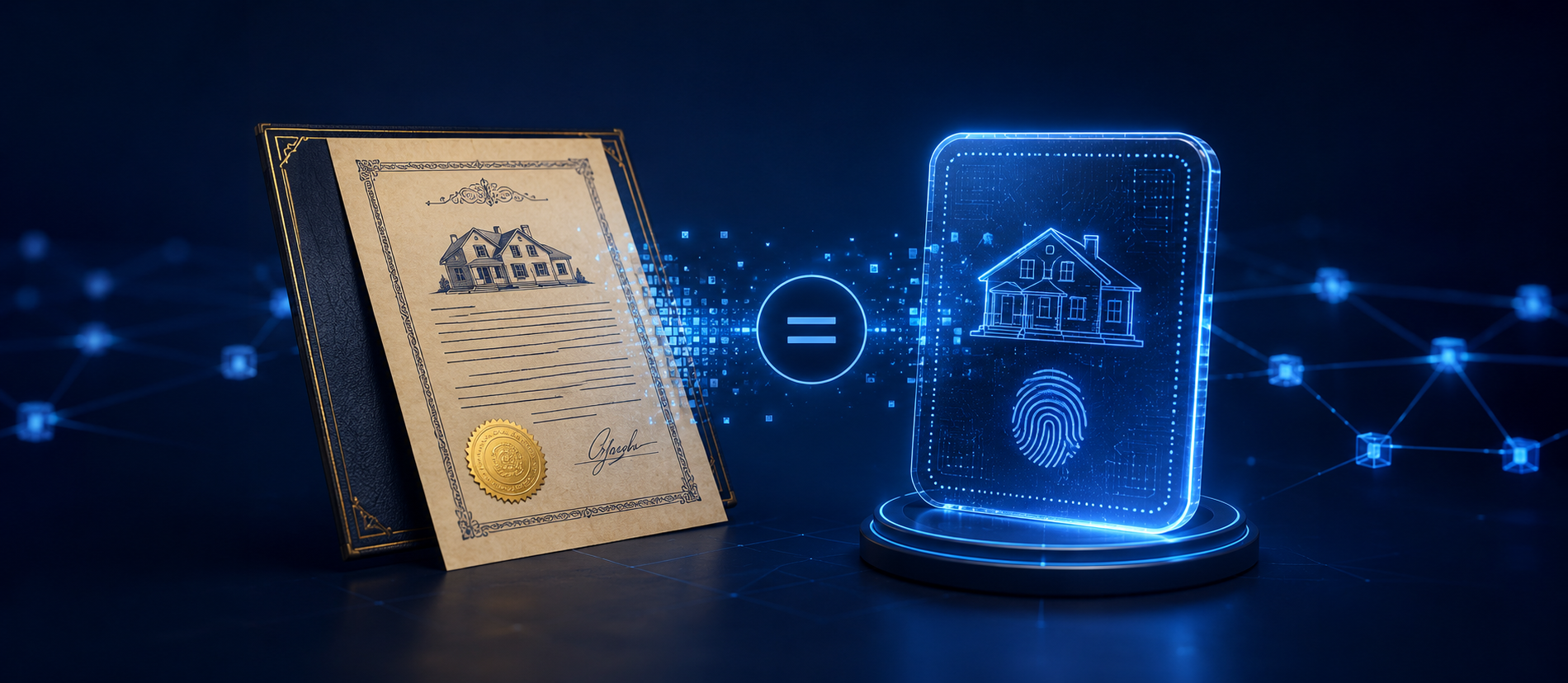
To understand NFTs, it helps to step away from technology for a moment and think about something far more familiar: a property deed.
The comparison explains why many technologists believe NFTs may eventually become one of the most useful applications of blockchain technology.
OWNERSHIP VERSUS THE ASSET ITSELF
Imagine you purchase a home. When the transaction is complete, you receive a deed.
The deed is not the house. You cannot live inside the deed. You cannot cook dinner inside the deed. You cannot sleep inside the deed.
The deed is simply the official record that proves ownership of the property. The document represents something valuable. It is not the valuable thing itself.
NFTs work in a very similar way.
An NFT, or Non-Fungible Token, is a unique digital record stored on a blockchain that represents ownership, rights, access, or authenticity associated with a specific asset.
Just like a deed represents ownership of a home, an NFT can represent ownership of a digital or physical asset.
WHY “NON-FUNGIBLE” MATTERS
The word “fungible” means interchangeable.
A dollar bill is fungible. If you trade one dollar for another dollar, nothing changes. They have equal value.
A share of stock in the same company is generally fungible as well. One share is equivalent to another share.
Property deeds are different. Every property deed represents a unique piece of land. No two deeds are identical because no two properties occupy the exact same location.
NFTs are called non-fungible because each one is unique. Every NFT has its own identity and can represent something distinct from every other NFT.
THE BLOCKCHAIN REGISTRY
Now imagine if property records were stored in a public ledger that anyone could verify. Instead of relying on filing cabinets, paper records, and local offices, ownership could be verified instantly by reviewing a shared system of record.
That concept is very similar to how blockchain technology functions.
The blockchain serves as a transparent ownership registry. The NFT serves as the deed. The blockchain records who owns it, when ownership changed, and where it currently resides.
Because the information is recorded on a distributed network, ownership records become easier to verify and more difficult to alter improperly.
NFTS ARE MORE THAN DIGITAL ART
Artwork was one of the first mainstream uses of NFTs, but the technology extends far beyond collectibles.
An NFT could represent:
- A concert ticket
- A membership pass
- A software license
- A gaming asset
- A vehicle title
- A certification credential
- A loyalty reward
- A node license
- A real estate title record
- Access to an online community
In each case, the NFT acts much like a deed or certificate. It provides proof that a particular person owns or controls a specific right or asset.
THE VALUE COMES FROM WHAT IT REPRESENTS
A common misconception is that NFTs are valuable simply because they exist. That is not how ownership works in the physical world, and it is not how ownership works in the digital world.
A property deed has value because of the property it represents. A concert ticket has value because it grants access to an event. A membership card has value because it unlocks benefits.
Likewise, an NFT derives its value from what it represents. The blockchain provides proof of ownership. The underlying asset provides the utility.
Understanding that distinction is one of the most important concepts in digital ownership.
WHY NFTS MATTER
For centuries, ownership records have been managed through paper documents, centralized databases, and institutional record keepers.
NFTs introduce a new model. Ownership records can now exist on a blockchain where they can be independently verified, transferred, and tracked.
The technology does not eliminate the need for laws, contracts, or trusted organizations. However, it can make ownership records more transparent, portable, and easier to verify.
In many ways, NFTs are simply the next evolution of something humanity has used for thousands of years: the ownership certificate. The deed. The title. The receipt. The proof that something belongs to someone.
The technology may be new. The concept is not.
DISCLAIMER
This article is provided for informational and educational purposes and should not be considered financial, legal, tax, or investment advice. NFTs, digital assets, and blockchain technologies involve risks and may not be suitable for all individuals. Always conduct your own research and consult qualified professionals before making financial or legal decisions.