
Staking is not a bank account or deposit product. Rewards are not guaranteed. Educational purposes only—not financial or investment advice.
When people first begin exploring blockchain technology, one of the terms they encounter most often is staking. At first glance, it sounds highly technical and can leave newcomers wondering if they need to understand complex computer systems before they can grasp the concept. Fortunately, the basic idea behind staking is much easier to understand than many people expect.
A helpful way to think about staking is to compare it to something many people are already familiar with: a traditional savings account or a certificate of deposit (CD). While the comparison is not perfect—and the two are certainly not the same—it provides an excellent foundation for understanding why staking exists and what purpose it serves within a blockchain network.
It’s worth noting upfront: staking is not a financial product, and this comparison is a mental model only—not a description of how returns or guarantees work.
THE CHECKING, SAVINGS, AND CD ANALOGY
Imagine you have money sitting in a checking account. Because you may spend or withdraw those funds at any moment, the bank has very little certainty about how long it can rely on that money being available. As a result, checking accounts typically earn little or no interest. Now imagine moving those same funds into a savings account. Since the money is more likely to remain deposited for longer periods, the bank may offer a modest return.
A certificate of deposit goes one step further. With a CD, you agree to leave your money deposited for a predetermined amount of time. Because the bank knows those funds will remain available during that period, it can plan accordingly—and it typically acknowledges that reliability. The key idea is that commitment creates stability, and stability enables the system to function more effectively.
HOW STAKING WORKS
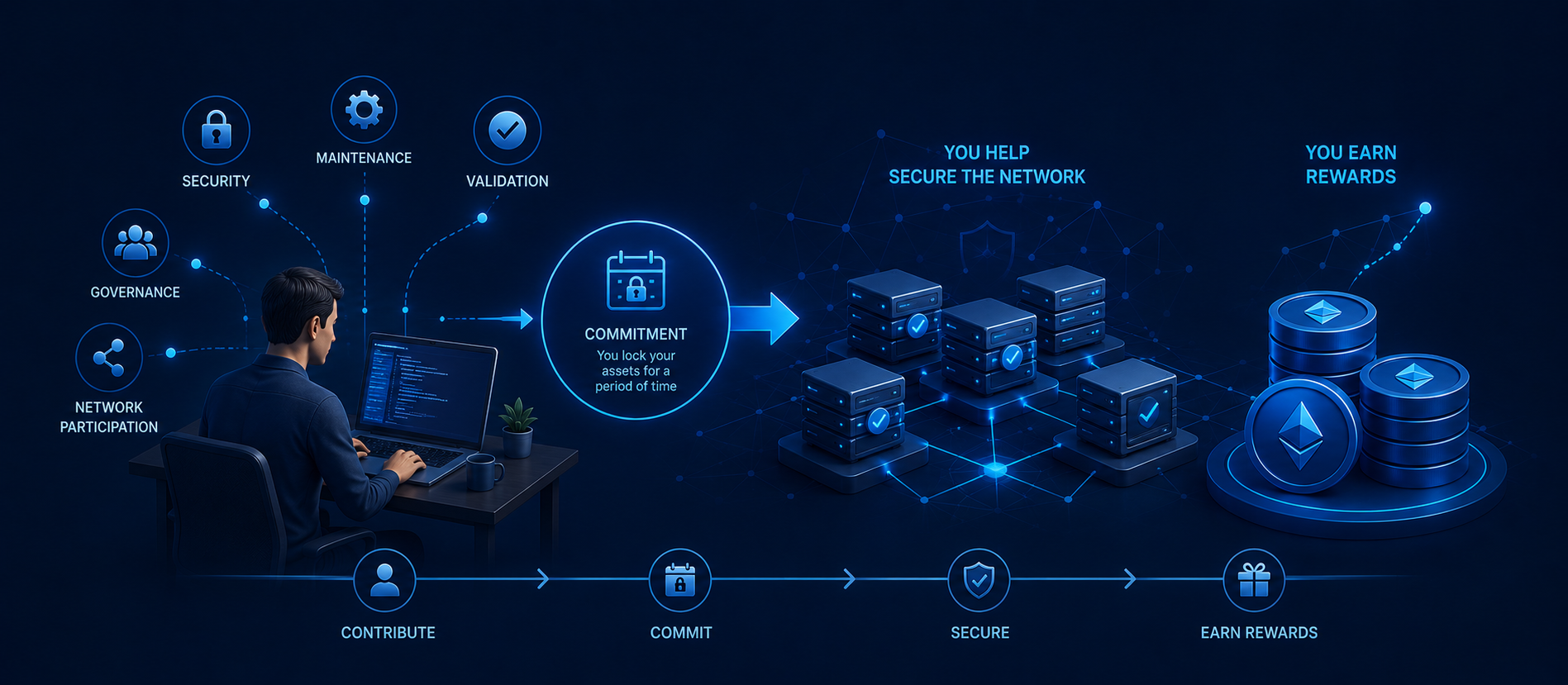
Staking follows a similar principle. Instead of depositing money into a bank, participants commit digital assets to help support the operation of a blockchain network. Depending on the design of the blockchain, those staked assets may help secure the network, validate transactions, support governance, or contribute to other essential functions. In recognition of their contribution, the network’s protocol may distribute rewards to participating members according to its rules—not as a financial return, but as an acknowledgment of their role in maintaining the network.
The important idea is not simply that rewards may be earned, but that staking encourages people to actively participate in maintaining the health and stability of the network. Blockchain systems are decentralized, meaning there is no single company or central authority responsible for operating everything behind the scenes. Instead, many participants work together to keep the network functioning properly. Staking helps align incentives so that individuals are encouraged to contribute to the network’s long-term success.
A GROWING CITY
An easy way to picture this is to imagine a growing city. Roads need maintenance, utilities require constant oversight, and public services must continue operating every day. None of those systems maintain themselves. They depend on people contributing time, resources, and effort to keep everything running smoothly. Blockchain networks operate much the same way. Staking encourages participants to provide the resources that help keep the network secure, reliable, and resilient.
WHERE THE ANALOGY ENDS
Of course, this analogy has its limits. A savings account or certificate of deposit is a traditional financial product offered by regulated banking institutions. In many jurisdictions, deposits may be insured, interest rates are generally known in advance, and the risks are relatively well understood.
Blockchain staking is fundamentally different. Rewards can vary over time, participation requirements differ from one blockchain to another, and some staking arrangements include lock-up periods during which assets cannot be freely accessed. In some networks, staked assets may be subject to penalties—sometimes called “slashing”—if a validator behaves improperly or goes offline. As with all blockchain participation, there is no guarantee of any reward, and the return of staked assets is not assured. Because every blockchain has its own rules, the experience of staking on one network may be very different from staking on another.
STAKING AS COMMUNITY PARTICIPATION
Perhaps the best way to think about staking is not as a savings account, but as participating in a cooperative community. Members contribute resources that help the organization function effectively, and the organization may reward those who contribute. In the blockchain world, participants help maintain decentralized infrastructure, and the network may recognize those contributions through its reward system.
This design is one of the reasons blockchain technology has attracted so much attention. Rather than relying entirely on centralized organizations to operate critical infrastructure, decentralized networks create systems where participants themselves help provide the security, validation, and governance needed for the network to thrive.
THE KEY TAKEAWAY
Understanding staking is an important step toward understanding blockchain as a whole. The savings account and certificate of deposit analogy provides a useful mental model because both involve committing resources for a period of time to support a larger system, with the possibility that the system may recognize that contribution. However, it is equally important to recognize where the comparison ends. Staking is not a bank account, nor is it a guaranteed investment product. It is a mechanism that many blockchain networks use to encourage participation, strengthen security, and support the long-term health of decentralized ecosystems.
As with many blockchain concepts, the terminology may sound unfamiliar at first. Once you relate it to everyday experiences, however, the underlying idea becomes much easier to understand.
DISCLAIMER
This article is intended for educational purposes only and should not be considered financial, investment, legal, or tax advice. Staking mechanisms, rewards, risks, and eligibility requirements vary significantly between blockchain networks. Always research the specific network and understand the associated risks before participating.